
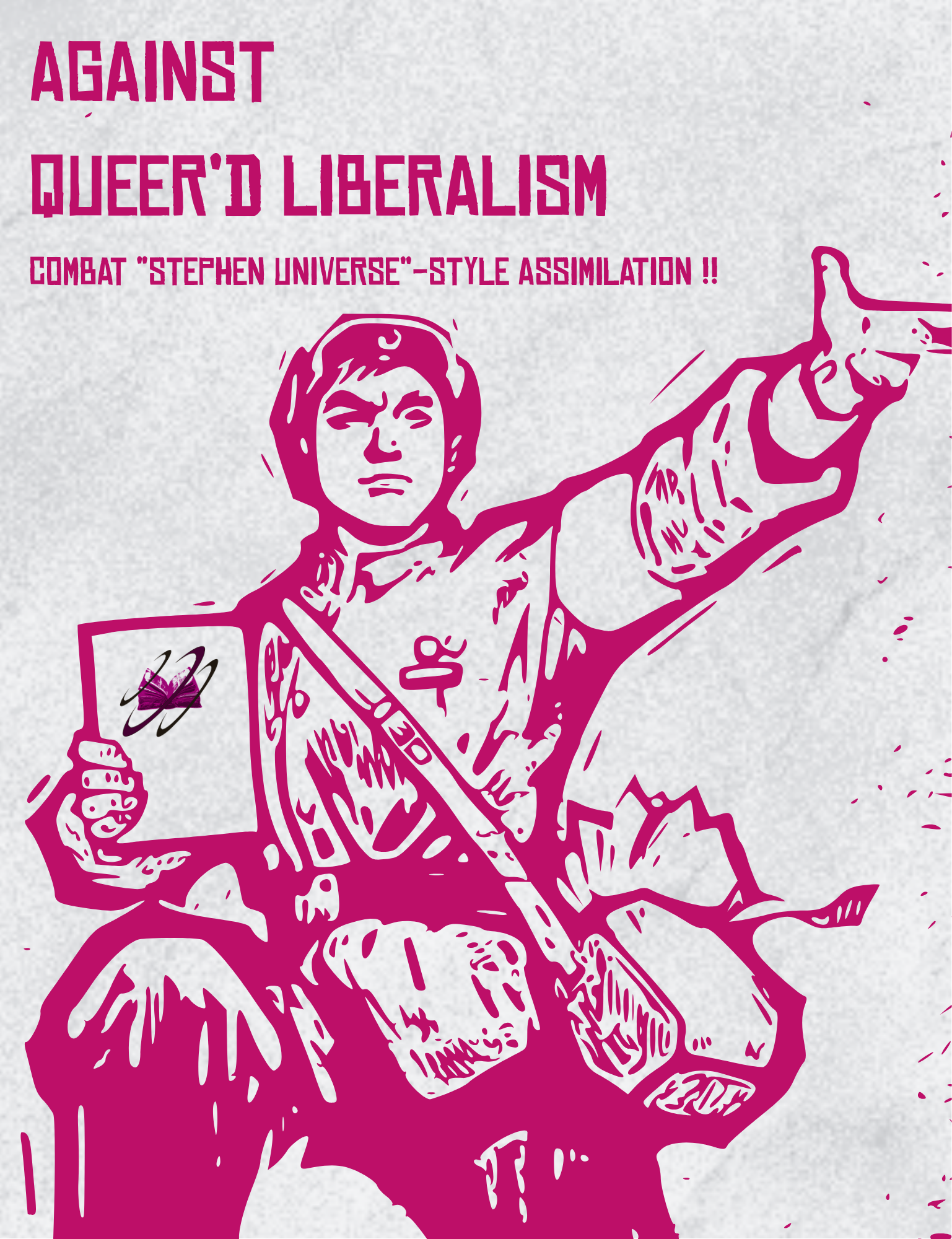
I. Preface
At the time of first writing, we were approaching the fifty-seventh
anniversary of the 1969 rebellion at the Stonewall that--- at least in
popular memory--- served as the launching-pad for the righteous and
glorious struggle for the ability of Queer people (gender, sexual, and
romantic minorities) to not only publicly live as themselves, but to
also exercise their independence and shape their own destiny for better
lives. At the same time as we approached such a jubilant occasion, we
are living in a time of heightened struggle against Queer people's
independence. In 2025 alone, twenty-nine American states passed over 120
new laws meant to attack and curtail the rights of transgender Americans
to live as themselves. Among these are laws that specifically attack
transgender and Queer people along line of class distinction. If gender
affirming care is unavailable in the area in which a working-class
person lives; if the discussion of topics relating to our lives is
prohibited, vast strata of the working-class are simply unable to "pack
up and move" to a safer area--- as is often recommended by some as a
weak bandage over the gash that has been inflicted upon the collective
community of Queer people.
This being said, the violence perpetrated against Queer people in
general and the Queer working-class in particular has been covered at
great length, and arguably with superior analysis than we may be able to
provide here. What must be discussed in the era of heightened struggle
is that there exists an internal contradiction among the Queer masses to
which little effort has gone into addressing. The psychologically
poisoning and castrating ideologies of liberalism and puritanism have
creeped their way into much of Queer space. Our goal here is not to
attack those who carry these wrong ideas, but to engage in a "ruthless
struggle" so as to weed out the backwards and dangerous ideas that
permeate a vast swath of discourse surrounding Queer people. It may be
argued that any such criticism of Queer discourse is but a bludgeon
against our own and that to criticize these ideas merely provides aid to
the enemy forces wishing to destroy us. However, as the great comrade,
Mao Zedong once said,
"To let things slide for the sake of peace and friendship when a
person has clearly gone wrong, and refrain from principled argument
because he is an old acquaintance, a fellow townsman, a schoolmate, a
close friend, a loved one, an old colleague or old subordinate. Or to
touch on the matter lightly instead of going into it thoroughly, so as
to keep on good terms [...] This is one type of liberalism."[1]
When incorrect and backward views permeate the airwaves and the
discursive spaces, it is our duty to maintain an upright and stead-fast
character in struggling against them.
II. All Ideas Are Stamped with the Brand of a Class
So, what are these backwards and incorrect views and attitudes being
parroted, and what makes them so? The central issue is of the ideologies
of puritanism and liberalism. In the discourse to which we pertain, it
is manifest as a consumerist, sexually repressed, philistine, liberal,
and fundamentally petit-bourgeois attitude that originates from the
newly Queer young masses of the petit-bourgeoisie. The attitudes that
breed so-called "cancellations" and treatise-length lists of attitudes
(correct and otherwise) the subjects of whom should fiercely obey the
warning of "Do Not Interact." The sex-negativity, scorn of creativity,
and sophomoric obsession with media as if these are the principal (or
indeed exclusive) struggles being waged: This is the attitude that we
are faced with combatting here.
To again borrow from Mao Zedong, all ideas and "every kind of thinking"
is "stamped with the brand of a class."[2] And the class branding of
any type of thinking is a central component in determining its
correctness. Put simply, ideas do not arise out of aether, nor do are
they ever-present. Ideas are born from one's material standing in the
world. Just as independence, creativity, and consciousness do not arise
from vacuous space--- they must be struggled for and ardently
supported--- neither are any perceptions, interpretations, or ideas.
Given that ideas arise from practice and one's practice is principally
informed by their class position, we must analyze these ideas from the
class position from which they originate.
Stemming from the notion that Queer people exist in all manner of
classes and take all manner of class stands (proletarian and reactionary
alike), camps and styles of Queerness arise. The camps that are we
centrally concerned with here are the liberal Queer of the philistine
"Steven Universe" style, and the proletarian Queer of the "Ketamine"
style. The specific objects mentioned in naming them, however, does not
provide an ample description of these styles of Queerness.
The "Steven Universe" style is centrally defined by its relationships
with media, the internet, a "respectable" politic, and sex-negativity.
Being that they are principally concerned with the image of
Queerness rather than the material basis. They could, in this vein, be
considered Queer idealists. They are pre-occupied with "identity" and
"representation" rather than the material standing of their community.
The origins of this style--- as may be apparent--- originate from a
strictly petit-bourgeois (and occasionally non-monopolistic bourgeois)
space of existence.
The "Ketamine" style is centrally defined by the subject's place in
their community. They are those who exist in physical (read: "offline")
spaces, engage critically with their community, and their Queerness is,
above all, material. Their Queerness is defined by the function of its
existence in material reality rather than in self-prescribed identity.
Their Queerness is production in a sense. The production of a certain
type of self and community rather than simple proclamation. This style
is centrally of a proletarian or lumpen-proletarian character and has
long been the driving and near-universally progressive force in the
struggle for Queer liberation. Whereas those of the "Stephen Universe"
style are content in engaging with endless "discourse," controversy, and
hypotheticals; those of this style engage materially and have a vested
interest in struggle against the currently dominant bourgeois
institutions which bind them. We cannot, it must be noted, exclusively
define the "Ketamine" style of Queerness exclusively in its role as a
negating factor opposed to the "Stephen Universe" style.
"Ketamine"-styled Queer people are not exclusively an oppositional
force. In fact, they are no anti-thesis at all. They are the original
thesis that wildly predates the "Stephen Universe" style.
Queerness in its original form is of the proletarian, "Ketamine"
style. The Queerness that was carved into the walls of nightclubs and
bars; the Queerness that was scrawled across subway cars. That is the
Queerness of this style. That is a proletarian Queerness. The Queerness
that "vogued"[3] in ballrooms where mothers[4] tended to their
adoptive children. As proletarian revolutionaries, this is the Queerness
that we are principally concerned with exalting and liberating.
III. The Lineage of the Stonewall Uprising
We would be dangerously remiss if we did not mention the radical,
working-class, and immensely progressive history of our fore-mothers.
The comrades who preceded us in the Queer liberation movement were
largely of a working-class and nationally oppressed (Black, Chicana, and
Puerto Rican) character. It would also be incorrect of us to proclaim
that Queer people did not exist publicly until the uprising of 1969. As
Amanda Yee noted in an article for Liberation News:
"Three years before the uprising at Stonewall, homeless queer and
trans youth led an uprising at in 1966 in San Francisco. Compton's
Cafeteria was an all-night diner in the Tenderloin district that was a
refuge for homeless queer and trans people, who were shut out of stable
housing by landlords and frequently targeted by police. In August of
1966, a cop grabbed a trans woman sitting in the diner, and she threw
coffee in his face, triggering an uprising where dozens of people fought
with police and even set a police car on fire."[5]
Furthermore, struggles for Queer liberation and against the false
constraints of bourgeois society at large predate even the uprisings and
cultural births and re-births of the 20th century. In the aftermath of
the Second American Revolution,[6] William Dorsey Swann, the first
"queen of drag," founded and lead the first Queer activist organization.
As Channing Gerard Joseph wrote in The Nation:
"[B]eginning in the 1880s, he not only became the first American
activist to lead a queer resistance group; he also became, in the same
decade, the first known person to dub himself a "queen of drag"---or,
more familiarly, a drag queen."[7]
From Swann's activism of the late 19th century, to Compton's Cafeteria
in the 20th, through the ballroom culture and political struggles of
the present day, the Queer movement, was, has been, and will continue to
be led by the masses of working Queer people and must continue to
reflect the class-stand with which it was originally forged.
Post-Stonewall, a number of organizations formed including the Gay
Liberation Front (GLF) and the Street Transvestite Action
Revolutionaries (STAR), the latter of whom were led by the great
comrades, Sisters Sylvia Rivera and Marsha P. Johnson. STAR is
particularly notable for their work with unhoused Queer youth, sex
workers, and the Queer working-class and lumpen-proletariat[8] at
large. It was these organizations that were at the forefront of not only
advocating for the political rights of Queer people, but for materially
providing for and improving the lives of our youth.
The question remains of how this historical context directly relates to
the styles of Queerness with which we are concerned. In the period
presently under discussion, the economic development of publicly Queer
people had been substantially retarded by the bourgeois-patriarchal
status-quo. This is to say that in many circumstances, the ability for
publicly and proudly Queer people to matriculate into classes beyond the
lumpen-proletariat and general working-class was profoundly hindered.
Indeed, entry into the general working-class was itself a continuous
challenge faced by all Queer people, for if one was privately Queer,
their identity was always a risk for them that--- if revealed--- could
dramatically limit their opportunities for employment, and if one was
publicly Queer, their opportunities for employment were ab ovo
reduced. Fundamentally, the criminalization and social-ostracization of
Queerness largely separated (specifically publicly) Queer people from
typical production by virtue of their Queerness. This is--- in part--- a
reason for the ruthless, relentless, and glorious struggle for the
rights of Queer people to engage in the productive process.
The retardation, suppression, and resultant lumpen-proletarianization of
the Queer masses is itself what gave birth to the style of Queerness
which we now identify as the "Ketamine" style. Queerness, being
relegated to the underground, became underground itself and as such
adopted the attitudes and character of the communities by whom they were
surrounded. Illicit drugs, sex work, and homelessness were common place,
as means of engaging with legal, heterosexual society were
slim-to-nonexistent. The proliferation of illicit drugs is the component
of this stage of Queer development that gives name to the "Ketamine"
style; however, extra-legal and arguably anti-social activity is
certainly not the totality of this style. In this style,
self-organization, chosen family, and self-advocacy became of paramount
importance. When bourgeois society has abandoned you, you must--- as
Assata Shakur said--- "love and protect one another."
This stage continued into the 1980s and the AIDS crisis occurring
therein. As the U. S. government stalled on the issue and then-President
Ronald Reagan not even daring to mention the disease until
1985,[9][10] communities were left again to fend for themselves in the
face of a disease that was and has continued to kill primarily Black,
Latine, Queer, and working-class people. Self-organization by, for, and
of affected communities was the only solution to prevent excess death as
the diseased ravaged communities and killed our foremothers. Queer
people volunteered to care for their friends and comrades as they
watched others succumb to illness. All the while, the dominant
bourgeois-society spread poisonous stigmas of "gay cancers" and
"righteous punishment."
Those comrades that remain of this era and those who continue to stand
in their lineage are undoubtedly of the proletarian "Ketamine" style of
Queerness. These are the people who bind communities together as a cord
stronger than one of titanium. They are those who continue to echo the
legacy of the respected comrades Rivera and Johnson, and those are who
carry forward the legacy of Queer liberation. Through every nightclub
meeting, through every pose and vogue, through the maintenance of our
culture and refusal of capitulation, these are the advanced fighters of
Queer liberation who are firm and steadfast in advancing the independent
character of the Queer masses.
IV. The Assimilationist Turn
We previously examined--- through a historical-material lens--- the
birth of what have referred to as proletarian or "Ketamine"-style
Queerness. That being said, for a thorough analysis of the contradiction
between the "Steven Universe" and "Ketamine" styles, we must also grant
a historical-material analysis to the "Steven Universe" style. It was
said previously that the "Ketamine" style is the original thesis,
and that the "Steven Universe" style presents an outgrowth thereof. To
say this is to say that "Steven Universe" Queerness may be defined in
terms of its relations to and is existentially contingent upon the
"Ketamine" style. At a fundamental level, the "Steven Universe" style is
the crystallization of the development of Queer independence that would
be unthinkable if not for the struggles waged by the original "Ketamine"
style.
Previously, we noted that the Queer development has been substantially
retarded by the oppression that Queer people have faced and continue to
face by bourgeois-heterosexual society. The development which would have
seen Queerness exist in all manner of class from the lumpen-proletariat
through the highest echelons of monopoly capitalism was ruthlessly
compressed into the lumpen-proletariat and the working-class. However,
as a direct result of the struggles waged by our foremothers of the
original style, the development of Queer people has accelerated and
resulted in the presence of Queer people in all classes. As the
struggles for Queer integration into wider society proved victorious,
Queer people managed to enter classes which to them were previously
forbidden. At present, Queer proletarians exist amongst a Queer
petit-bourgeoisie, and indeed Queer capitalists. While still ultimately
subordinate to heterosexual society, Queer people gained access to a
newer degree of class mobility that--- with quite rapid pace--- launched
them from a relatively backwards mass of people to a developed mass ripe
for new forms of exploitation and co-optation by the forces of bourgeois
capital.
Queer people became more publicly visible and as such, there became a
new identity for whom the bourgeoisie could produce commodities. The
assimilationist turn came principally with the advent of Queer people
who could independently shape their own destiny and who--- often with
capital--- "bought in" to the bourgeois heterosexual society that had
long held them beneath its heel. Without the rabid criminalization and
lumpen-proletarianization of the preceding centuries,[11] Queer people
were able to engage more freely with the wider society. This
development, however progressive historically, was a double-edged and
dialectical sword. As a new petit-bourgeois strata of Queer people
emerged, the ideas of assimilationism, respectability, and a
fundamentally opportunist capitulation to capitalist/heterosexual
society emerged. Campaigns that may have previously fought for the
fundamental liberation of Queer and other oppressed peoples--- centered
on the liberation of the working-class--- shifted to simple
"acceptance," "tolerance," or "representation" of and for Queer people.
It is from this period--- the period lasting from the 1990s pax
Americana to around the 2015-16 "pre-Trump" era--- that the ideas that
would crystallize into assimilationist and "Stephen Universe" Queerness
would emerge. This is not to say that the advancement of political,
economic, and social rights for the Queer masses was not progressive in
the historical sense. It was certainly progressive; it was progressive
in the sense that the development of any community through
historical-material stages is progressive. It was progressive in the
sense that lives were materially improved. This being said, Marxism is
not teleological and with as with any progressive current,
contradictions will continue to emerge. The transition from slave
society to feudalism was progressive. The transition from feudalism to
capitalism was progressive. Through these progressive epochs, however,
there will always been new problems to be rectified.
The assimilationist line that developed in this period, fundamentally
evacuated Queerness of its class character and was principally focused
on the new strata of petit-bourgeois Queer people and their interests.
It focused on "respectability" and "representation" and fundamentally
presenting Queerness as something congruent with bourgeois society. This
is wrong. Put simply: it is wrong, because it neglects the material
reality that Queer liberation is working-class liberation. If
Queerness is entirely compatible with bourgeois-society, then it ceases
to exist and distinct phenomena. Furthermore, it then distances itself
from the liberatory movements that struggled and died for the
development of the Queer masses to begin in the first place.
This period's emphasis on "identity" and assimilation into mainstream
structures stripped the movement for Queer liberation of the very
transgressive character that allowed for the development of Queer people
as a stratum.
The focus on "identity" also has further philosophical errors, which
will be addressed in forthcoming chapters. The most pressing issue is
that the liberal sense of "identity" is inherently metaphysical and
idealist. It claims "identity" as existing outside of oneself and yet
simultaneously entirely within one's body-mind, rather than as a
socially-constructed process built through one's community labor. As we
continue to explore the infantile syndrome of liberal and "Stephen
Universe"-style Queerness, we will return to the notions of
ideal-metaphysical "identity" as opposed to material identity.
V. Forged Online
Having analyzed the origins of the "Ketamine" style and broader Queer
liberalism in great detail. We must now examine the particularly
internet-centered character of the "Stephen Universe" style and the
conditions of the specific areas of the internet from which it
originates.
The liberalization of Queerness came as a direct result of the
development of Queer society and the matriculation of publicly Queer
people into various classes; however, this does not (at least
exclusively) describe the formation of the "Stephen Universe" style.
Unlike what may generally be considered liberal or assimilationist, the
"Stephen Universe" style does not regard itself as such and still exists
with full knowledge of--- and a certain degree of resistance to--- its
marginalization. The "Stephen Universe" style is still "alternative" in
the subcultural sense, while still lacking in the proletarian and
rightly progressive character of the "Ketamine" style. The "Stephen
Universe" style in this sense could be considered a backwards synthesis
or an expression of the more general contradiction between proletarian
and petit-bourgeois Queerness.
So, on the matter of the internet--- the internet has, through
interest-based and engagement-rewarding algorithms, produced a level of
alienation and atomization of subcultures and societies hitherto thought
impossible. Social media platforms will one show a person what they
choose to engage with and as such contains an immense propensity for the
creation of "echo chambers" wherein little thought outside the bounds of
the subculture may permeate. With each individual siloed into their
insular subculture, the alienation first theorized by Marx and Engels---
alienation of man from his labor--- takes on a new form. Man is
alienated from his very sense of self.
Whereas we have decreed that personhood and identity are complex and---
like any material processes--- constantly in motion, the atomization of
individuality into labeled subcultures leaves one with precisely the
"bound knot" of identities that the metaphysicist would declare they
were to begin with. Interests, communities, and the general
particularities of being are compressed into simple descriptors. This
turbo-alienation or "atomization" is what has led to the formation of
the "Stephen Universe" style of Queerness. If identity is a bound knot
of interests compressed into a subcultural label or "aesthetic," and if
its material basis--- in all meaningful sense--- is entirely obfuscated,
then it becomes inevitable that one would conceptualize their identity
from an idealist perspective. After all, in this space existence is
defined not by the material processes from which life hath sprung forth,
but from one's own self-identification on a page. A page--- it must be
noted--- that may itself be entirely divorced from any notions of
reality.
The internet, of course, is not an exclusively negative factor; however,
the atomization resulting from the current stage of bourgeois social
media must be noted for firm analysis. The "Stephen Universe" style's
obsession with media, with optics, with presentation, and with
"respectability" is the natural conclusion of a social structure that is
based merely in the ideas of existence rather than existence itself.
It is an expression of the abstraction of personhood which occurs in the
social media space. This is, again, not to say that the internet has not
had extraordinary wonders. The ability to nigh-instantaneously
communicate with billions across the world is alone enough to say that
the internet is a progressive structure. That being said, under a
bourgeois-dominant system, a structure that is fundamentally progressive
may be distorted and perverted. The goal of the internet is not to
connect individuals to each other, nor is its goal to fulfill any other
social function. At a fundamental level, it is another vehicle by which
a small handful of corporations and billionaires may increase their
profits and enrich themselves.
To summarize, it is the atomization of communities, the flattening of
identity, and the abstraction of personality which gives to the "Stephen
Universe" style its backward character. If one is only fed their
present, comfortable, petit-bourgeois, and consumerist existence--- if
that is all one knows, then the possibility of material community
becomes terrifying. Those of the "Stephen Universe" style are not
backwards through moral failing, they are simply the other men in
Plato's cave.[12]
VI. Portrait of Stephen Universe-Style Queerism
At this point, we have touched on elements of "Stephen Universe" -style
Queerness and the origins, history, and material foundations in the
development of Queer society; however, we have neglected to paint a
complete and detailed portrait of the styles of Queerness whom we are
referencing. The principal question remains: Who is the "Stephen
Universe" Queer?
The "Stephen Universe" style of Queerness "synthesizes"[13] the
assimilationist and pseudo-"respectable" tendencies of the liberal,
petit-bourgeois Queer with a thin coating of progressivism or
"alternative" -ism. It is not progressive or liberatory in the sense
that it has material effect on the standing of Queer people in wider
society so much as it refers to itself as "progressive" or
"alternative" in the sense that it is superficially opposed to Queer
oppression and dominationism at large. However, despite this superficial
opposition, the "Stephen Universe" style is entirely compatible with
the aforementioned oppression and constitutes no significant resistant
force to such oppression.
Engagement--- however uncritical and undialectical--- with media is a
central feature of this style. To the "Stephen Universe" the roles of
"fandom" spaces, cultural consumption, and "representation" are vastly
overstated to the extent of constituting a totality of the meaning of
Queerness. Queerness--- in their view--- is not a material process with
material standing. It is an idea; it is an identity that one
ascribes to themself rather than it being ascribed to them through
engagement with a given community.
Relating to their perspective of Queerness as a self-prescribed identity
that exists beyond the material, the "Stephen Universe" style is unique
in its role as a distractive force that engages in endless "discourse"
and what could be sophomorically described as a superficial "theory"
that does not, in any way, contain any elements of practice. It is from
this realm--- from the domain of "Stephen Universe" -style Queerness---
that unhelpful and long- answered questions such as the "validity"[14]
of lesbians using masculine pronouns and the presence of sexual "kinks"
at Queer events and during Pride arise. From the perspective of the
"Ketamine" style, these questions have been thoroughly answered and
explored by their foremothers; however, this unveils another critical
distinction between the "Stephen Universe" and "Ketamine" styles. The
"Stephen Universe" style, born through the atomizing character of the
bourgeois internet, is obfuscated from its lineage. Of course, this
cannot simply be blamed on the internet.
Queer history has long been suppressed and erased going back millennia.
The suppression of this history serves a purpose which is precisely its
effect. Atomized Queer people are divorced from their
(lumpen)proletarian history and revolutionary character of struggle.
This goal aligns closely with wider bourgeois society. If a significant
mass of people is alienated from their long history of struggle, then
they will know not where even to "begin" in the process of struggling
against the oppressions that continue to exist.
Also worth noting in a rigorous portrait of the "Stephen Universe" style
is the youth of those who take on the style. While not exclusively
composed of adolescents, the "Stephen Universe" style of Queerness
frequently takes on a sophomoric simultaneously self-infantilizing and
self-aggrandizing attitude that is a common feature of adolescence. The
retort that one is "literally neurodivergent and a minor"[15] is the
most salient example of the "Stephen Universe" style. Atomized Queer
teenagers from whom their history has been obfuscated are likely to find
solace on an internet that may initially appear friendly to them. We
must admit that, however idealist it may be, it would be erroneous of us
to deny the benefits conferred by access to a space in which one may
dissociate themself from their present conditions.
The conditions of Queer adolescents--- particularly those with mental
illnesses or other neurodivergences--- are exceptionally hostile in
general society and internet algorithms (and the corporations by whom
they are controlled) take advantage of this. It is under these
circumstances that certain Queer adolescents may be siloed off into
their insular media-centric communities and adopt the "Stephen Universe"
style. The importance of these communities to them (and their importance
in these communities) becomes the basis of their identity rather than
their material standing in reality. They are effectively the Lost Boys
in Neverland who are terrified of aging. The drama that exists within
their subcultures becomes the totality of struggle, and the maintenance
of these subcultures becomes primary of the struggle for liberation in
material reality.
We must lastly acknowledge the puritanism and negativity towards sex
that is abundant in the "Stephen Universe" style. On its face, Queer'd
puritanism appears different than the "Christian purity culture" that is
ever-dominant in the United States. However, it is effectively the same
phenomenon painted in new varnish. To define our terms, the
puritanism to which we are referring is generally characterized by
the repudiation of the particularly sexually counter-cultural character
of the "Ketamine" style. To provide an example, consider a sexual
proclivity that is generally considered "deviant" like "Puppy
Play."[16] Those of the "Stephen Universe" style have repeatedly
expressed desires to exorcise the community from all manner of Queer
discourse and Queer representation. They mindlessly parrot the refrain
that sexual expression should remain behind closed doors and out of
common consciousness. This is in sharp contrast to the fact that "Pups"
have been engaging publicly (with a degree of obvious decency) with
Queer culture and Queer community for longer than the vast majority of
those of the "Stephen Universe" style have been on this Earth. In fact,
longer than their mothers and grandmothers have been on this Earth.
Their argument comes with the alleged justification that it is "poor
optics" and inhibits the ability of "normal" Queer people to engage in
bourgeois-heterosexual society. Put simply, it is a liberal
respectability politic wrapped in the "sheep's clothing" of liberation.
Furthermore, this emphasis on "optics" and general assimilationism is
often accompanied by a repudiation of the sexual in general and a moral
denunciation of the sexually "deviant" in particular.
To summarize, the "Stephen Universe" style of Queer person is one
alienated and atomized. She is divorced from her history, and she
retains the puritanical and assimilationist backwardness of the society
that reared her. In forthcoming chapters, we will paint a similarly
analytical portrait of the "Ketamine" style and elucidate how to
struggle against petit-bourgeois ideals of the "Stephen Universe" style.
VII. Portrait of Ketamine Queerism
Having explored the nature and character of the "Stephen Universe" style
at great length. We must now take a moment to examine the same for the
"Ketamine" style.
Whereas, we have described the "Stephen Universe" style as "entirely
compatible" with existing structures of oppression, no such backwardness
is true of the "Ketamine" style. The "Ketamine" style, having been
forged in the fires of lumpen/proletarianization, is fundamentally
incompatible with the systems of oppression which have led to its
creation. The "Ketamine" style is diametrically and fundamentally
opposed to the institutions of oppression from which it was born.
A principal aspect of the "Ketamine" style worth examining is their
relationship with physical communities and a general non-engagement
with the internet subcultures deemed so dominant in the "Stephen
Universe" style. Whereas, the "Stephen Universe" style was forged on
Tumblr pages and through various atomized subcultures of the internet,
the "Ketamine" style was birthed from and typically still found in,
bars, nightclubs, and almost exclusively adult, and material
communities. Not only are these communities material--- as in
actually existing in reality--- but they are by-and-large working-class
and adult communities wherein the progressive character of the
working-class may show itself. They are third-spaces outside the view of
the ire of capital.
Now we would be remiss if we failed to address the potentially
anti-social or otherwise societally unacceptable facets of the
"Ketamine" style. The "Ketamine" style may contain--- but need not be
exclusively defined by--- drug use, unsafe sexual practices, and/or
crime; however, we must recall that all of these are an active
by-product of the oppression that many of the style face. They are still
oppressed both by virtue of being working-class or lumpen-proletariat,
and still are oppressed by virtue of being Queer people. It would be an
error of significant order if we were to simply moralize these
facets of the "Ketamine" style through the metaphysical lens of
bourgeois society. All of those so-called "anti-social" or
"unacceptable" aspects of the style are a direct material result of the
continued (lumpen-)proletarianization of the Queer masses. Further to
the point above, Queer people are wildly overrepresented in populations
of unhoused people (particularly unhoused youth), populations engaged in
sex work, and populations experiencing addiction or other mental health
challenges.
All of this being said, it is still not the "Stephen Universe" style of
Queer person who is engaged in struggles for the liberation of Queer
people from all forms of oppression--- including those which result in
the displeasures above. The Queer people who perform every form of
community-building service from distributing "DIY" hormone replacement
therapy (HRT) to carrying overdose-reversing medication and drug-testing
kits are undoubtedly and nigh-universally of the "Ketamine" style.
VIII. Combat Discourse; Against the Puritanical Line
At this point, we have repeatedly approached the quality of the
"Stephen Universe" style that has them endlessly preoccupied with
presentation, "optics," and so-called "discourse." And in
referencing the childlike bickering that they call discourse, we must
make a clear and present distinction between genuine inquiry and
productive ideological struggle and their ceaseless quarrels. Whereas
productive inquiry or ideological struggle is conducted on the basis of
genuine action and moving forward, "Stephen Universe"-esque discourse
insists that the principal mode of struggle is through simple debate on
matters of what Queer people are "allowed" where, how "valid"
certain people are, or how palatable we are to the
bourgeois-cishet-supremacist society that has a vested interest in
preventing our liberation.
In combatting this line, however, we cannot deny its assertions on their
face. We must be rigorous and thorough in our understanding of this
position and the reasons for which it is politically backwards.
Notably, this "discourse" is largely concerned with instruments of
popular perception--- primarily being mass media and the presence of
certain people (often of the "Ketamine" style) in certain spaces. The
"issue" that our friends of the "Stephen Universe" style identify is
that there is a type of Queer person that the oppressive society will
accept and one that it will not. They claim that to suppress those whom
society will not accept would be a progressive force in the struggle for
Queer liberation. The principal error here being that this society will
not genuinely accept any form of Queer person unless acted upon by a
force of transgressive popular power. To say this another way, we cannot
be saved from an oppressive system by appealing to the structures and
attitudes of that same system. This is what has produced the
liberal-assimilationist line that we have already seen has not played
out in our favor.
Let us investigate this more thoroughly with a case-study. Every June,
those of the "Stephen Universe" style make a consistent effort to
rehash the question of whether or not kink-based communities should be
allowed at or incorporated into pride events. Their line tends to fall
into the following points: (1) kink communities are inherently sexual
and deviant and thereby should not be included on those grounds alone,
(2) even if kink communities are not inherently anti-social, they
project a negative image on to many Queer people and thereby should not
be included for "optical" purposes, and (3) because of the previous
reasons, these communities should be excluded from Queer/pride spaces on
the grounds that their inclusion would give the bigoted right-flank a
new cudgel with which to beat us.
On the first point, it is worth pointing out that when this argument is
made, there is a seldom any material analysis being done of whatever
behavior or community to which they are objecting. Put simply, "Stephen
Universe"-style discourse does not provide any meaningful reason or
justification as to why certain communities are degenerate. When
arguments against this claim are made, it would seem that such
arguments, at their core, can be reduced to "it makes me feel icky" or
"it's abnormal." Beyond the flagrant metaphysical error of ascribing
an ontological "badness" to a thing without understanding its
conditions, formation, or purpose; it is worth noting that these
arguments are completely devoid of any reference to a particular harm
that is caused by whatever community or behavior they are describing.
Ironically, this seems to be the same bourgeois-heterosexual "purity
culture" that we have--- and indeed many of the "Stephen Universe"
style would--- critique at length. Kink, non-standard pronoun usage, and
other such atypicalities are said to be deviant simply because they are.
The born-again evangelical could (and indeed does) make the same
non-arguments about all Queer people.
Now on the subject of "optics," I suppose that the question here
depends on several factors: in who's eyes do we want to be viewed
positively and as acceptable, and what benefit is gained through being
optically pleasant? Those of the "Stephen Universe" style tend to lack
an answer to both. They would argue that we want to be viewed as
positive to all people--- and while a noble ideal, it is simply
incompatible with the fact that we will always have an enemy. There will
always be a force that would prefer the subjugation of Queer people
rather than our liberation, and it is not worth wasting our precious and
finite time trying to win over these hostile forces. On the matter of
how we benefit from positive optics, it certainly depends on any given
situation, but a dogmatic application of optical pleasantries would not
only leave behind a significant subset of Queer people--- particularly
those of the "Ketamine" style--- but it would be yet another force
pulling us in the direction of assimilationism. If our acceptance is
conditional, then it can certainly disposed of if conveinient.
The third epithet that those of the "Stephen Universe" style may hurl
towards socially transgressive or heterodox communities is the claim
that regardless of the truthfulness of the material or optical harm
supposedly caused by such communities, our enemies will certainly assert
them as truth. Furthermore, they claim that the enemies of Queer
liberation would simply utilize the inclusion of these heterodoxies as a
weapon with which they may continue to villify, oppress, and repress the
totality of the Queer masses. "We musn't hand them a new cudgel with
which to beat us," they will proclaim. This assertion has a number of
problems--- all of whom can be summarized in a simple question, "why
should we negotiate with terrorists?" It would be absurd to proclaim
that our enemies would cease their unrelenting attacks based simply on
us moving toward their position. Those backwards fighters for
bourgeois-heterosexual society already view Queerness with a
nigh-inexhaustable contempt. To them, Queer existence is transgressive
enough in and of itself. If we were to move even a single centimeter in
their direction, they would find a new vehicle through which to launder
their attacks. There are no solutions are to be found in capitulation to
abject hatred and oppression--- the solution is to abolish such concepts
all together!
Taken generally, the "Stephen Universe"-style discourse is simply
another expression of that style's compulsive drive towards
"acceptance" in mainstream bourgeois society. It cannot be truthfully
said that any material harm is caused by kink or any other such
"transgressive" community, and it is equally incorrect to claim that
the right-flank would simply relent in the face of our capitulation. We
are not playing a game of "optics" or "acceptance;" we are playing
the game of liberation, and that sits comfortably in the domain of
the "Ketamine" against the palatable "Stephen Universe."
IX. Conclusions
It is at this point that we must transition from simple identification
of and ideological confrontation with the "Stephen Universe" style
into the mode of action. We could interpret this sphere from dawn until
dusk, but the point of the matter is to change it. So the question
remains, What is to be done?. We have firmly established the
"Stephen Universe" style as existing at the intersection of liberal
co-optation, internet-fueled atomization, and the general immaturities
of youth, and all three of these frustrations may be effectively
combatted through the integration of those of the "Stephen
Universe" style into practical political work. Certainly they cannot
yet lead, but they are not entirely backwards in the sense of being
unworthy of our time and discussion. Many of this style accurately
identify that they face structural oppression on a number of axes. They
may even identify capitalism as the culprit of this oppression, and it
would be a grave error to simply deny them the means to advance
politically and shape their destiny on the grounds of their more liberal
style. In fact, it is practical political work--- contact with reality,
if you will--- that would serve as the transformative engine driving
them away from the "Stephen Universe" style and into a more advanced
All of the axes on which Queer people of the "Stephen Universe" style
lay fundamentally disconnect them from the material realities and
struggles of wider life. Liberal co-optation poisons their minds with
the notion that those of the "Ketamine" style are "unclean" or
otherwise unscrupulous. Internet atomization pulls them apart from one
another and silos each individual into a personalized "echo chamber"
that becomes more difficult to leave as time goes on; and youth itself
is defined by a lack of practical experience in the world. The common
thread of all of these shortcomings is a disconnect between the
"Stephen Universe" style and material struggle. The method, then, for
effectively combatting this style is to incorporate those "Stephen
Universe"-esque fighters who approach political advancement into
practical work. To paraphrase the great comrade, Mao Zedong: if they
would like to know the taste of the pear, than they must participate in
the act of changing it by eating it. We wish for those of the "Stephen
Universe" style to truly know advancement, they must participate in the
act of changing the world. The "dead-end" nature of their ceaseless
"discourse" and optics-driven capitulation will become self-evident to
them. Furthermore, the successful tactics of practically building up
political work with a proletarian stand will too become self-evident.
This purpose of this text was never to issue a dogmatic condemnation but
to ideologically struggle against a backwards stand that has been taken
up by a noticible portion of Queer people. These people are not "lost
causes;" they simply require thorough engagement with practical
reality. In a quest to unite all who can be united, we must have a
concrete processes to identify problematic tendencies among people who
may otherwise be allies. The "Stephen Universe" style is not a fixed
permanent essence; it is a natural result of the conditions that many
Queer youth face in the present times. And because it is a natural
result of existing conditions, it can be combatted by changing those
conditions. To borrow from an internet maxim, the solution to the
"Stephen Universe" problem is to make them touch grass.
- Mao, Zedong. "Combat Liberalism." In Selected Works of Mao
Tse-tung, Vol. 2. Marxists Internet Archive. Accessed June 18, 2026. ↩︎ - Mao, Zedong. "On Practice: On the Relation Between Knowledge and
Practice, Between Knowing and Doing." In Selected Works of Mao
Tse-tung, Vol. 1. Marxists Internet Archive. Accessed June 18, 2026. ↩︎ - "Voguing" is a style of dance that was created by Black and Latine
working-class Queer people in the 20th century as a part of the
wider "ballroom" culture among them. This culture was and is home to
chosen families, joy in the face of immense oppression. (National
Museum of African American History & Culture, "A Brief History of
Voguing") ↩︎ - The leaders of the various "ballroom houses" were frequently trans
women referred to as "mothers." (Wikipedia, "Ball culture") ↩︎ - Yee, Amanda. "53 years ago: Queer liberation's roots were
socialist, working class and anti-imperialist." Liberation News,
December 26, 2023. ↩︎ - Comrade Harry Haywood's term for the American Civil War and
Reconstruction era (c. 1861-1877) ↩︎ - Joseph, Channing Gerard. "The First Drag Queen Was a Former
Slave." The Nation, January 31, 2020. ↩︎ - We will address the "lumpen-proletarian question" later on, but
for our purposes we effectively mean sex workers who general--- and
particularly in the context of Queer liberation movements--- make up
a "revolutionary stratum of the lumpen-proletariat." ↩︎ - Kirchick, James. Secret City: The Hidden History of Gay
Washington. New York: Henry Holt and Company, 2022. ↩︎ - This was 4 years after the Centers for Disease Control (CDC)
reported the beginning of the outbreak in 1981, and after 5,000
people had already died in the United States. ↩︎ - Homosexuality was 'de jure' legalized for the whole of the United
States in 2003. ↩︎ - We are referencing the allegory of the men in the cave from
Plato's Republic. Having spent all their lives in the cave, the men
are terrified of the outside world. When its existence is revealed
to them, and they execute the person who first revealed it. ↩︎ - In the sense of eclectically combining backwardness and
advancement, and more specifically in the sense of a post-hoc
"mashing" of liberal Queer-isms with the veneer of
"alternative"-ness and progressivism. ↩︎ - The centrality of "validity" in online and "Stephen
Universe"-style discourse is another common feature. We will not
address it in detail here, but put simply the idea that "validity"
in one's identity supersedes the need for liberation is another
expression of the idealism present in this style. ↩︎ - A retort that has been overused and exaggerated to the point of
ironic usage by the present. ↩︎ - Also known as Puppy and Handler (PAH), this "kink" involves
erotic roleplay as a dog or other domesticated animal. We cannot
address the entirety of it here, and it mostly serves as a
placeholder for any consensual (between adults), non-conventional
sexual behavior. ↩︎